Home » Posts
Struggling with the ACSM 030-444 exam? Get real ACSM 030-444 mockup questions, all six exam domains explained, eligibility requirements, a proven study plan, and 5 clinical practice questions with detailed answers - everything you need to pass the ACSM Certified Clinical Exercise Physiologist exam on your first attempt.
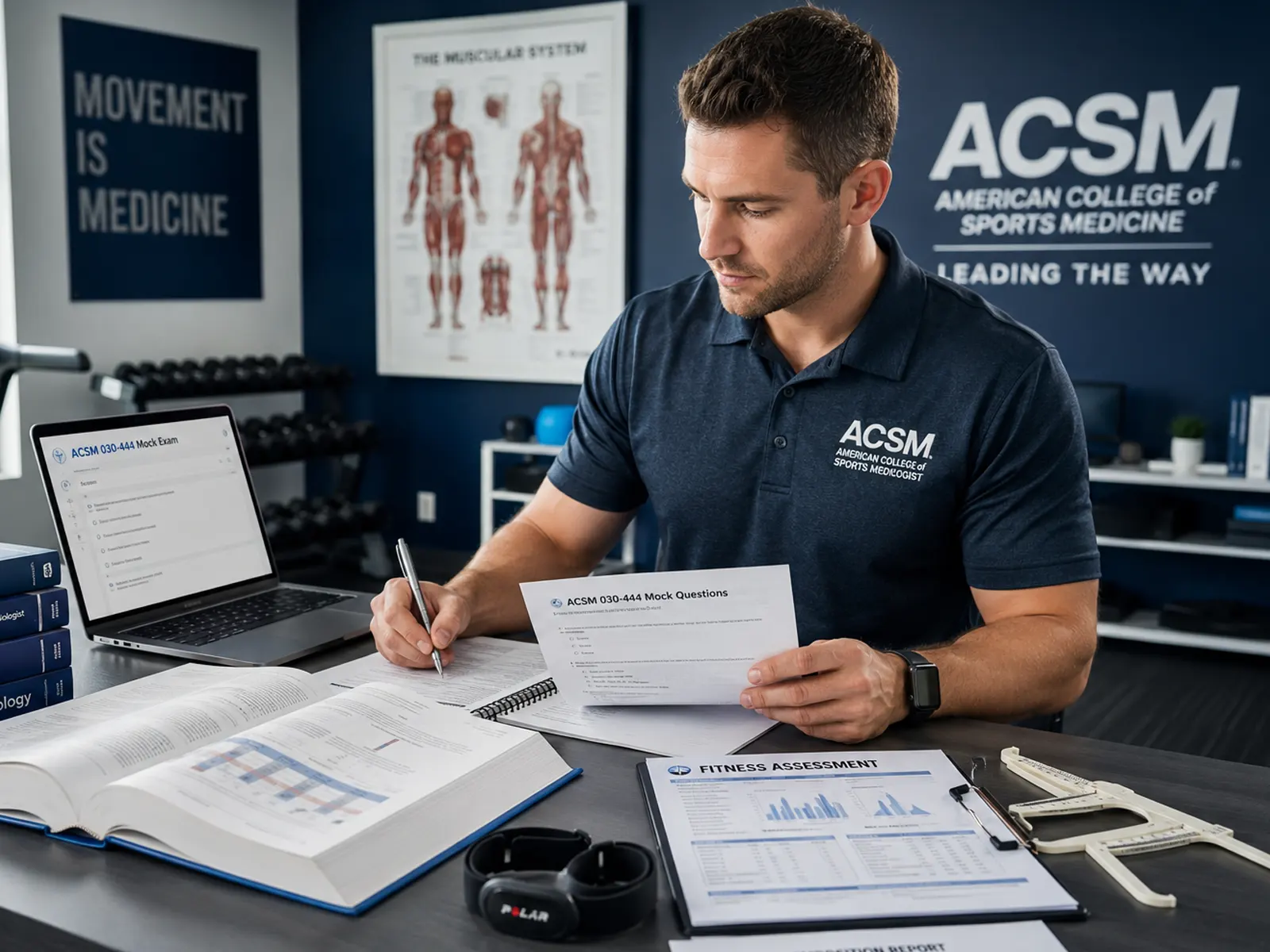
The ACSM 030-444 exam is not the kind of test you can wing with a few days of reviewing notes. It covers six clinical domains, draws from three recommended textbooks, and asks you to make real judgments about real patients - all in 210 minutes, with no references in front of you. People who have years of clinical experience still fail it the first time because they studied the wrong way.
This guide covers everything: what the certification is, exactly who qualifies, what the six exam domains test, how the scoring works, and a set of ACSM 030-444 mockup questions at the end to show you where you actually stand.
The full name is ACSM Certified Clinical Exercise Physiologist. It's one of the flagship credentials issued by the American College of Sports Medicine - not the entry-level ACSM-EP (Exercise Physiologist), but the clinical-tier certification designed for professionals working directly with patients who have chronic diseases and conditions.
The ACSM-CEP works with people who have cardiovascular disease, pulmonary conditions, metabolic disorders like diabetes, orthopedic and musculoskeletal conditions, neurological diseases, cancer, and immunologic or hematologic conditions. Your job is to prescribe and supervise exercise as part of a healthcare plan - in hospitals, cardiac rehab programs, outpatient clinics, and chronic disease management programs.
Places like Cleveland Clinic, Mayo Clinic, and AACVPR-accredited cardiac rehab facilities actively hire ACSM-CEPs. The credential signals that you can function as part of a clinical team, not just a gym floor.
One important update: as of July 10, 2025, all ACSM certification exams - including the 030-444 - align with the 12th edition of the Guidelines for Exercise Testing and Prescription (GETP 12). If you're using older prep materials, they may be referencing outdated protocols. Double-check before you trust any resource.
There are two pathways, and both require documented clinical experience:
| Education | Clinical Experience Required |
|---|---|
| Bachelor's degree in Exercise Science or equivalent | 1,200 hours of hands-on clinical experience |
| Master's degree in Clinical Exercise Physiology | 600 hours of hands-on clinical experience |
The experience has to be clinical - meaning direct patient contact in a healthcare setting, not fitness center floor work. Cardiac rehab, pulmonary rehab, hospital-based exercise programs, outpatient clinical exercise testing - those count. General personal training does not.
ACSM defines the CEP as an allied health professional. That framing matters: this credential is positioned alongside physical therapists, respiratory therapists, and other clinical practitioners, not alongside personal trainers. The eligibility requirements reflect that distinction.
Here's the setup when you walk into the test center or log into the remote proctoring platform:
That's about two minutes per question. Most will take less. The ones that burn your time are synthesis-level questions - cases where you're given a patient scenario with vitals, history, and symptoms, and you have to decide the right clinical action. Those questions require reasoning through multiple pieces of information simultaneously, not just recalling a guideline.
ACSM structures questions at three cognitive levels. Recall questions test whether you know a fact or protocol. Application questions ask you to interpret simple results or implement a process. Synthesis questions - the hardest - ask you to analyze a situation, weigh competing clinical factors, and make a judgment call. The exam has all three, and synthesis questions are where underprepared candidates lose points.
The first-time pass rate for the ACSM-CEP hovers around 65%. That number improves significantly with structured preparation and timed practice under closed-book conditions.
ACSM publishes a full Exam Content Outline (ECO) - the official blueprint for every question on the 030-444. As of the July 2025 update, six performance domains make up the exam. Here's how the scoring weight breaks down:
| Domain | Percentage of Exam |
|---|---|
| Domain I: Patient Assessment | 18% |
| Domain II: Exercise Testing | 18% |
| Domain III: Exercise Prescription | 22% |
| Domain IV: Exercise Training and Leadership | 24% |
| Domain V: Education and Behavior Change | 13% |
| Domain VI: Legal and Professional Responsibilities | 5% |
Domains III and IV together account for 46% of the exam. If you have limited study time, that's where to spend most of it.
This covers everything that happens before a patient starts exercising. You need to know how to review medical records under HIPAA and HITRUST regulations, interpret vital signs using clinical reasoning, assess resting biometrics including 12-lead ECG, and determine appropriate supervision levels based on preparticipation health screening.
A key tool here is the PAR-Q+ (Physical Activity Readiness Questionnaire for Everyone) and the ACSM preparticipation screening algorithm. Expect questions on when to refer a patient back to a physician before clearing them for exercise. You also need to understand patient-centered goal setting - using open-ended questions, active listening, and motivational interviewing techniques.
This domain also tests your knowledge of pathophysiology. Knowing what an MI looks like on an ECG, or how COPD affects resting oxygen saturation, is expected. You're working with chronic disease populations - you can't assess what you don't understand.
Everything about exercise testing: selecting the right protocol for a given patient, administering it properly, interpreting results, and knowing when to stop a test. This covers submaximal aerobic tests (treadmill protocols like Naughton, Bruce, Ellestad; cycle ergometer tests; 6-minute walk test), maximal symptom-limited testing, musculoskeletal fitness assessments, and body composition testing.
For each test type, you need to know the appropriate population, the normal and abnormal endpoints, and the effect of common medications on test results. Beta-blockers, for instance, blunt the heart rate response to exercise - a patient on metoprolol will have a lower max HR than predicted. Applying that knowledge to interpret a test result is the kind of application-level question you'll see.
Body composition assessment comes up too: understanding BMI limitations, skinfold measurement protocols, and how to interpret results across different chronic disease populations.
This is the core of clinical exercise physiology. You need to prescribe exercise using the FITT-VP principle - Frequency, Intensity, Time, Type, Volume, and Progression - for apparently healthy populations and for every major chronic disease category: cardiovascular, pulmonary, metabolic, orthopedic, neurological, cancer, and immunologic/hematologic conditions.
Each disease category has its own considerations. Cardiac patients in Phase II rehab have target HR ranges based on exercise testing results or medications. Diabetic patients need blood glucose monitoring before and after exercise. Pulmonary patients use ratings of perceived dyspnea alongside RPE. COPD patients may need supplemental oxygen guidance.
Expect the prescription questions to be scenario-based: "A 62-year-old woman with Type 2 diabetes and hypertension is cleared for exercise by her physician. Which of the following is the most appropriate initial prescription?" These questions test whether you can integrate multiple clinical factors, not just recall FITT principles in isolation.
The largest domain. It covers what happens during actual exercise sessions with clinical populations: monitoring patients during exercise, recognizing and responding to abnormal signs and symptoms, modifying programs in real time, and leading group or individual sessions safely.
You need to know the indications to stop an exercise session - absolute and relative - and what to do when you observe them. A patient on a treadmill who develops ST depression on telemetry, chest tightness, or a blood pressure drop with increasing workload needs an immediate, correct response. This domain tests whether you can make those calls.
It also covers program management: documenting sessions, communicating with the healthcare team, adapting programs for different settings (cardiac rehab, outpatient, home-based), and understanding equipment used in clinical exercise settings.
This domain bridges clinical work and health behavior science. You need to know the major behavior change theories - Transtheoretical Model (stages of change), Social Cognitive Theory, Health Belief Model - and how to apply them when a patient is resistant to exercise, struggling with adherence, or dealing with psychological barriers.
Motivational interviewing techniques come up regularly. So do questions about health literacy, how to communicate exercise recommendations to patients with different educational backgrounds, and how to screen for psychosocial issues like depression and anxiety that affect exercise adherence.
One subtopic worth extra attention: the psychological effects of chronic illness. A cardiac patient dealing with fear of re-infarction during exercise, or a cancer survivor with fatigue-related barriers - these are real clinical challenges and the exam tests whether you know how to address them.
The smallest domain but don't skip it. These questions cover scope of practice, documentation requirements, informed consent, emergency procedures, professional liability, and ethical responsibilities. Scope of practice questions are particularly common - knowing what an ACSM-CEP can and cannot do relative to physicians, physical therapists, and registered dietitians is important.
Emergency action plan knowledge also falls here: what to do if a patient collapses, experiences a cardiac event, or has a hypoglycemic episode during an exercise session.
ACSM officially recommends three resources:
ACSM's Guidelines for Exercise Testing and Prescription, 12th Edition (GETP 12) - The primary reference. As of July 10, 2025, all exam questions align with this edition. Every prescription guideline, testing protocol, and clinical threshold you need is in here. This is non-negotiable.
ACSM's Certification Review, 6th Edition - Built specifically for exam prep. Organized by domain, with practice questions. Use it alongside GETP 12 rather than instead of it.
ACSM's Clinical Exercise Physiology, 2nd Edition - The deep-dive reference for disease-specific exercise programming. If you work with cardiac rehab patients daily, much of this will be familiar. If your clinical background is narrower, this fills the gaps.
ACSM also offers an official online prep course with 27 modules grouped into five sections, available through the ACSM store. It's expensive but structured - good for candidates who learn better with audio and guided content than from reading textbooks.
Here's the sequence that produces first-attempt passes:
Week 1–2: Gap analysis. Download the official Exam Content Outline from ACSM's website. Go through every domain and every job task. Rate your confidence honestly - strong, shaky, or blank. Build your study plan from the gaps, not from what's comfortable.
Week 3–5: Primary reading. Work through GETP 12 systematically, cross-referencing the ECO as you go. Focus especially on the exercise prescription chapters for each chronic disease population. These directly map to Domains III and IV - 46% of the exam.
Week 6–7: Disease-specific deep work. Use ACSM's Clinical Exercise Physiology for the conditions outside your clinical experience. Most candidates have strong backgrounds in cardiac or metabolic work but weaker knowledge of pulmonary, neurological, or oncology populations. Fill those gaps deliberately.
Week 8–9: Timed ACSM 030-444 mockup questions. Full 100-question sessions with the clock running. Closed-book, no looking anything up. This is where your preparation becomes real. Anything less than timed practice under exam conditions is not preparation - it's reading.
Final week: Weak spots only. Your practice scores will tell you exactly which domains are costing you points. Spend this week there. Don't review what you already know well.
Book the exam when you're consistently hitting 72–75% on full timed practice sets. The real exam is harder in wording, and edge-case questions will drop your score 5–8 points below your practice average.
Five questions - one from each of the five main clinical domains. These match the format and cognitive level of actual exam questions.
Question 1 - Patient Assessment
A 58-year-old male patient with a history of coronary artery disease, hypertension, and Type 2 diabetes presents for his initial evaluation in a cardiac rehab program. His resting ECG shows normal sinus rhythm. His resting blood pressure is 148/92 mmHg. He takes metoprolol, lisinopril, and metformin. Before developing his exercise program, the ACSM-CEP should:
A) Begin a submaximal treadmill test to establish baseline aerobic capacity B) Proceed with program enrollment since he has physician clearance C) Review his medical records, medication timing, and blood glucose levels, and assess his current functional status D) Refer him back to his cardiologist since his resting blood pressure exceeds 140/90 mmHg
Answer: C
A comprehensive patient assessment must happen before any testing or program design begins. Medical record review, medication reconciliation, and functional assessment are all foundational steps. His resting BP of 148/92 is elevated but not an absolute contraindication for assessment - the threshold for postponing exercise testing is resting BP above 200/110 mmHg. Referring him back to cardiology at this point, without further assessment, would be premature. Option B ignores the need for individualized clinical evaluation.
Question 2 - Exercise Testing
A 64-year-old woman with COPD (FEV1/FVC ratio of 0.62) is referred for exercise testing. Which of the following protocols is most appropriate for initial aerobic exercise testing?
A) Bruce Protocol treadmill test B) Naughton Protocol treadmill test C) Åstrand-Ryhming cycle ergometer test D) 1.5-mile run test
Answer: B
The Naughton Protocol uses small, gradual workload increases - typically 1 MET per stage - making it appropriate for deconditioned patients and those with chronic cardiopulmonary disease. The Bruce Protocol starts at a higher initial workload and increases more aggressively, which is inappropriate for COPD patients with limited ventilatory reserve. The Åstrand-Ryhming is a submaximal cycle test that assumes a normal heart rate response - problematic in patients on bronchodilators or with abnormal HR responses. The 1.5-mile run test has no place in clinical populations with pulmonary disease.
Question 3 - Exercise Prescription
A 55-year-old man recently completed Phase II cardiac rehab following a myocardial infarction six weeks ago. His functional capacity from a symptom-limited graded exercise test is 7 METs. He is asymptomatic at 85% of his maximal heart rate. His physician has cleared him for an outpatient exercise program. What is the most appropriate initial aerobic exercise prescription?
A) 70–85% of maximal heart rate, 30–45 minutes, 3–5 days per week B) 40–50% of heart rate reserve, 20–30 minutes, 3 days per week C) 50–70% of VO2 reserve, 45–60 minutes, 5 days per week D) Maximal effort, 20 minutes, 2 days per week
Answer: B
For a post-MI patient transitioning out of Phase II cardiac rehab, the initial outpatient prescription should be conservative. ACSM guidelines recommend starting at 40–50% HRR (heart rate reserve), building duration gradually before increasing intensity. A 7-MET functional capacity is moderate-good, but the goal in early Phase III is safe progression, not maximizing intensity from day one. Option A is too aggressive for an initial prescription in a recently post-MI patient. Option C pushes volume and intensity simultaneously. Option D has no place in cardiac populations.
Question 4 - Exercise Training and Leadership
During a group cardiac rehabilitation session, a 67-year-old patient reports chest tightness rated 2 out of 4 on the angina scale while walking on the treadmill at 3.2 mph. Her heart rate is 112 bpm and blood pressure is 156/88 mmHg. Telemetry shows 1 mm ST depression in leads II, III, and aVF. What is the most appropriate immediate action?
A) Reduce treadmill speed to 2.0 mph and monitor for symptom resolution B) Stop the exercise session, have the patient sit or lie down, notify the supervising physician immediately C) Continue at the current workload since her symptoms are mild and blood pressure is acceptable D) Administer sublingual nitroglycerin immediately
Answer: B
ST depression combined with angina symptoms during exercise is an absolute indication to stop the exercise session. This is not a situation to manage by reducing speed - it requires immediate cessation, positioning the patient safely, and physician notification. Administering nitroglycerin is outside the scope of practice for an ACSM-CEP without a direct physician order in the immediate setting. Continuing at the same workload would be clinically dangerous. The combination of ECG changes and anginal symptoms demands an immediate, definitive response.
Question 5 - Education and Behavior Change
A 45-year-old woman with Type 2 diabetes has been referred to a clinical exercise physiologist for exercise counseling. She tells you she knows exercise is important but says she "just can't make herself do it consistently." She's tried three different gym memberships in the past two years and stopped each time within six weeks. She doesn't appear to lack knowledge about exercise benefits. Which behavior change approach is most appropriate?
A) Provide her with a detailed written exercise plan and set a start date B) Use the Transtheoretical Model to assess her stage of change and tailor your counseling to address ambivalence and barriers C) Refer her to a mental health professional since her repeated failures suggest clinical depression D) Recommend a supervised group exercise program to increase accountability
Answer: B
Her pattern - repeated attempts followed by dropout - suggests she may be cycling between contemplation and preparation stages without successfully moving to action and maintenance. The Transtheoretical Model (Stages of Change) provides a framework for meeting a patient where they are. Assessing her stage and using motivational interviewing to explore ambivalence, identify real and perceived barriers, and build self-efficacy is the evidence-based approach. Option A ignores the behavioral root of the problem. Option C over-pathologizes a common pattern. Option D might help but skips the foundational step of understanding why she keeps stopping.
Several platforms offer practice question banks for the 030-444:
OpenExamPrep offers 200+ free ACSM-CEP practice questions organized by domain, with explanations - no signup required. Good for initial diagnostic testing.
Examzify has a full ACSM-CEP flashcard and practice question set covering all six domains with detailed answer explanations.
CertEmpire and Pass4Future both offer timed simulators with 030-444 specific question banks updated through 2026.
ACSM's official online prep course - 27 modules, audio and slides, built directly around the Exam Content Outline. It's the most expensive option but also the most aligned with what actually appears on the exam.
Whatever you use, verify the prep material aligns with the 2025 ECO and GETP 12. Anything based on the 11th edition or the pre-2025 content outline will have gaps and inaccuracies.
The ACSM 030-444 is a credential that puts you in the room with seriously ill patients. The exam is built to test whether you belong there - whether you can assess, prescribe, monitor, and adjust with clinical judgment, not just follow a template.
Use the ACSM 030-444 mockup questions above as your starting calibration. Strong on all five? Move to full timed practice sets immediately. Shaky on two or more? Go back to the corresponding ECO domain, identify the specific job task you missed, and study from there.
The 65% first-time pass rate is not a ceiling. With a structured plan, the right references, and honest timed practice, it's very beatable.